Meet our crew and learn first-hand from professionals working across Australia’s marine industry. Here are some authentic career journeys, from apprentices to business owners and Super Yacht Captains.
“Being able to work on the water every day in a role that is hands-on and operational is something I really value.”
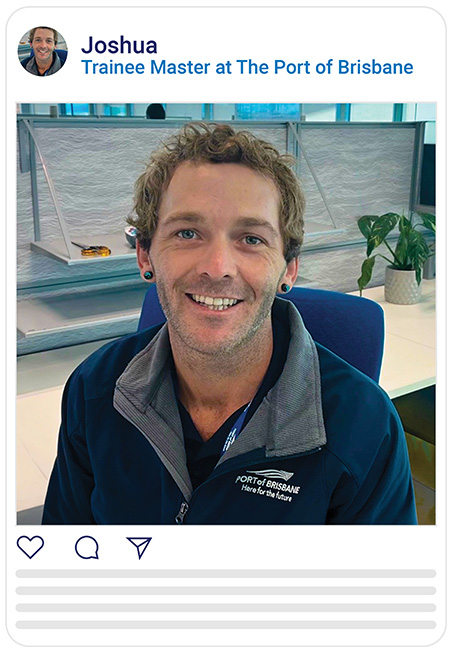
Joshua
Trainee Master at Port of Brisbane
Joshua transitioned from 12 years in construction to pursue his lifelong passion for working on the water. Now a Trainee Master at the Port of Brisbane, he operates dredgers, survey vessels and other specialist craft while building his qualifications toward Master <24m and beyond.
Joshua values the handson nature of maritime work, the strong safety culture, and the clear progression pathways. His journey shows that with determination, basic tickets, and practical experience, such as through Marine Rescue Queensland, anyone can build a rewarding longterm career in the marine industry.
I’ve always had a strong connection to the water. With family involved in fishing and the local tug and pilot boat industry, I was exposed to maritime from a young age. That early exposure inspired me to pursue a long-term career in the maritime industry.
I got started in the industry after seeing an advertisement for a marine traineeship on SEEK and successfully applying for the role.
Before moving into maritime, I worked in construction for around 12 years in FIFO roles. I made the decision to take a pay cut to transition into the marine industry, but it has been extremely rewarding to pursue a career I’ve always wanted. The traineeship has given me the opportunity to gain hands-on experience and build my qualifications while working in a real operational environment.
In my current role as a Trainee Master at the Port of Brisbane, I am training to operate a variety of vessels including dredgers, survey vessels, and bed levelling vessels. My day-to-day duties involve assisting with vessel operations such as vessel handling, docking manoeuvres, engine room checks, basic servicing, and completing operational documentation.
We typically operate with two crew members on board, working an hour on and an hour off. While one person is on the helm, the other completes preventative maintenance, engine checks, or required paperwork to ensure the vessel is operating safely and efficiently.
The role is very hands-on and requires strong communication, situational awareness, and a strong focus on safety.
I am currently completing my Certificate III in Maritime Operations (Master <24m Near Coastal), along with my Marine Engine Driver qualifications, which are helping me build both vessel handling and mechanical knowledge.
From my previous construction career, I already held licences such as dogging, which gave me a strong understanding of lifting and load control operations. I have also completed my basic rigging qualification, along with confined space and working at heights training, all of which are highly relevant to working safely on vessels.
These skills have helped me transition into the maritime industry by giving me a strong safety mindset, practical mechanical awareness, and confidence working around heavy equipment and operational environments.
The most rewarding part of my career so far has been making the transition into an industry I’ve always wanted to be part of. Being able to work on the water every day in a role that is hands-on and operational is something I really value.
I also find it rewarding knowing I am building a long-term career in an industry with strong progression opportunities and ongoing learning.
Maritime is a great place to learn and progress. You can start with your basic tickets, I already had my maritime safety skill set and Coxswain Grade 2. I also worked for a maritime construction company to get some work experience.
The maritime industry is a great place to learn and build a long-term career. My advice would be to start by getting your basic tickets and looking for opportunities to gain practical experience on the water.
Marine Rescue Queensland (MRQ) is also a very good starting point for young people coming into the industry. It provides valuable on-water experience, helps build confidence around vessels, and exposes you to real-world marine operations in a structured and safety-focused environment. I’m also a member of Marine Rescue Queensland and have seen first-hand how valuable that experience can be for building confidence and practical marine skills.
Gaining any hands-on experience you can, even outside of commercial operations, can make a big difference when trying to enter the industry. Its also important to have a strong safety mindset, be willing to learn from experienced crew, and be prepared to start at entry level and build your experience over time.
I think the maritime industry is heading toward increased use of technology, particularly in areas such as survey work, dredging operations, and vessel automation. We are already seeing more advanced systems being introduced to improve safety, efficiency, and environmental outcomes.
What excites me most is how technology will support crews in making operations safer and more efficient, while still requiring skilled people to operate and manage these systems. The industry is constantly evolving, which means there will always be opportunities to learn new skills and continue developing professionally.
Over the next 3–5 years, my main goal is to complete my traineeship and continue building sea time and operational experience across a range of vessel types. I would like to progress into operating larger vessels and continue further study toward higher-level qualifications such as Master IV, and eventually working toward Master 500. I’m focused on building a long-term career in the maritime industry and continuing to develop both my technical skills and operational knowledge.
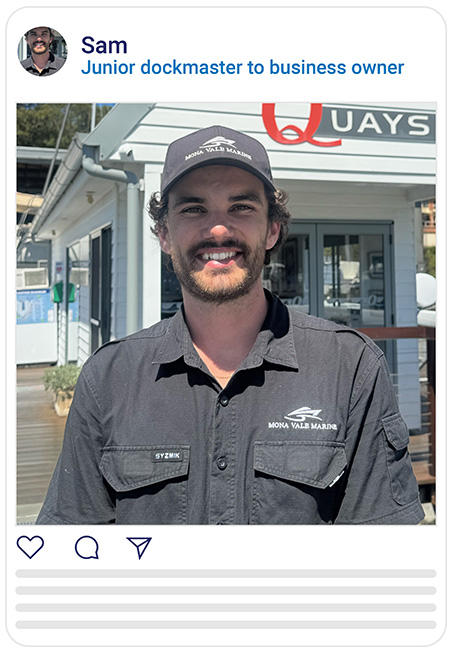
At just 14, he began working part-time as a Junior Dockmaster at The Quays Marina.
Sam
Junior Dockmaster to Business Owner
Sam Johnson has spent most of his life on the water, turning a childhood love of boating into a thriving marine career. At just 14, he began working part-time as a Junior Dockmaster at The Quays Marina — the very place where his own business, Mona Vale Marine, is now proudly based. His early responsibilities included tender operations, vessel fuelling, marina maintenance and assisting boat owners, providing him with a strong, hands-on introduction to the industry.
After leaving school at the end of Year 10, Sam committed to a marine mechanical apprenticeship, completing his Certificate III in Marine Mechanical and Technology at TAFE NSW. Two years after finishing his apprenticeship, he took the leap into business ownership, establishing Mona Vale Marine Pty Ltd — specialising in servicing and repairing inboard and outboard petrol engines, and representing the Epropulsion brand.
Running his own company at just 24 has been Sam’s proudest achievement so far. While the journey has come with challenges and a steep learning curve, he credits the supportive network of businesses and operators at The Quays Marina for helping him navigate those early stages. Alongside strong technical foundations, Sam has developed valuable people skills and communication abilities that have been essential to building trust with clients.
He encourages young people to explore the industry widely, noting that one qualification can open doors to many pathways — from marine mechanics to superyachts, ferries and beyond. Having overcome dyslexia during school, Sam values the opportunities the industry has given him to excel through practical learning and hands-on experience.
Looking ahead, Sam is excited about emerging technologies, particularly advancements in lithium batteries and evolving propulsion systems — developments he sees as both challenging and full of opportunity. Over the next few years, his goal is to grow Mona Vale Marine, build a skilled team and take on apprentices so he can pass on the same opportunities that helped shape his own career.
I grew up on the water, enjoyed it, and loved boating. When I was 14, I started a part time job at The Quays Marina on Pittwater, where my own business “Mona Vale Marine” is now proudly based.
My first job was a ‘Junior Dockmaster,’ operating the Tender Service, fuelling vessels, keeping everything clean and tidy, as well as assisting boat owners around The Quays Marina.
I left school at the end of Year 10 and, after completing some work experience, started my apprenticeship. Studying at TAFE Ultimo for 3 years to complete a Cert III in Marine Mechanical and Technology.
I run my own business, Mona Vale Marine PTY LTD, and I’m a servicing and repair specialist for inboard and outboard marine petrol engines. I started my business just over 12 months ago, 2 years after completing my apprenticeship.
Starting my own business has been challenging to say the least; it’s a steep learning curve. There are many aspects to the business that you don’t see as an employee.
I’ve found the industry very supportive, especially the other businesses and the marina team here at The Quays Marina in Pittwater.
I run my own business, Mona Vale Marine PTY LTD, and I’m a servicing and repair specialist for inboard and outboard marine petrol engines. I started my business just over 12 months ago, 2 years after completing my apprenticeship.
Starting my own business has been challenging to say the least; it’s a steep learning curve. There are many aspects to the business that you don’t see as an employee.
I’ve found the industry very supportive, especially the other businesses and the marina team here at The Quays Marina in Pittwater.
My apprenticeship in Cert III Marine Mechanical and Technology, as well as honing my people skills.
I guess to be able to do what I’m doing at a young age, I’m 24 years old and running my own business.
The industry is vast. An apprenticeship in one trade can lead to other opportunities, for example, working on superyachts or driving passenger ferries. An apprenticeship can provide a good base to discover what you really like about the marine industry.
The marine industry has really helped me as I struggled with dyslexia at school, but I was always open to learning. The Cert III gave me a chance to excel.
Technology is constantly changing, which is both challenging and exciting. And I feel like lithium batteries will have their place, therefore providing me with new skills.
To grow my business and develop a team of mechanics. I’d like to take on apprentices and give back the opportunity I have been given.
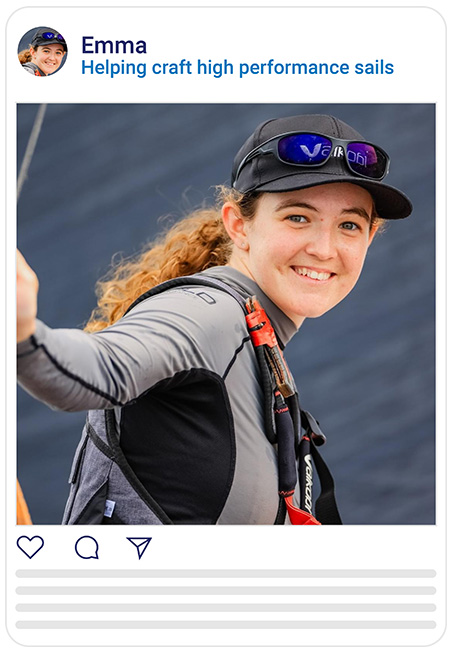
Emma found her way into the marine industry through school sailing programs and Bayview Sea Scouts.
Emma
Helping Craft High Performance Sails
Emma Rankin found her way into the marine industry through school sailing programs and Bayview Sea Scouts, despite not coming from a sailing family. Her passion for the sport grew steadily—progressing from NS14s to match racing and later Hobie Cats—before establishing herself on the elite 18-foot skiff circuit. She now skippers the 18-footer "Club Marine", recently making history as the first female skipper to win a race in the NSW Championships.
Alongside her competitive sailing career, Emma has spent the past seven years working at Contender Sailcloth, a global manufacturer of performance sailcloth and sail hardware. The role gives her the flexibility to train, travel, and compete while contributing her design and technical skills to the business. After studying Industrial Design at UTS, Emma now uses software to prepare sail files, calculate cloth requirements, oversee CNC cutting processes, and coordinate with sailmakers—ensuring each set of sail panels is precisely produced for their intended performance.
She is largely self-taught in her technical work, balancing ongoing skill development with the demands of high-level competition. For Emma, some of the most rewarding moments come from seeing boats race with sailcloth she has helped produce—such as the renowned TP52 fleet.
Emma encourages aspiring sailors to pursue careers that complement their competitive ambitions, as industry experience can open doors to better boats, bigger regattas, and professional sailing opportunities. Looking ahead, she is excited by the evolution of sailing technology and is passionate about keeping sailmaking skills onshore in Australia, where local knowledge truly matters.
Over the next few years, Emma hopes to continue advancing both her professional and competitive careers, with a dream of securing a position in the SailGP racing series while continuing to build her expertise in the marine industry.
I don’t come from a sailing family; I got into the sport through my school learn to sail program and latterly at Bayview Sea Scouts. After school I studied Industrial Design at UTS, which has certainly helped in my current role at Contender Sailcloth.
My competitive sailing career has progressed from NS14’s through to match racing and Hobie Cat’s.
I am currently competing and skippering, on an 18 foot skiff “Club Marine” making recent history as the first female skipper to win a race in the NSW Championships.
When not competing and travelling to compete, I have been working at Contender Sailcloth for the last 7 years.
Contender Sailcloth are a global company who manufacture sail cloth products including spinnakers, laminates, and sail hardware. I’m fortunate that the role offers me flexibility and the ability to continue to compete.
When I started match racing, I scrolled through a community Facebook group and saw this role advertised.
My customers send me an order via email, with a file and details of what cloth they’d like the sail cut from. Using software, I set up the file, calculate how much cloth is needed and communicate back to the sailmaker if there are any issues. We then cut out the fabric out on a 12 meter long table with a CNC cutter. Once the fabric is cut, we organise the panels and ship them to the sailmaker.
I’ve been self-taught, to be honest, as it’s difficult to manage any formal learning with the competitive nature of my sport.
Being able to explore the sport, to travel and compete. Seeing boats racing using sail cloth they have ordered from Contender, for example the fleet of TP52’s, where I have been involved in the cutting of the sail cloth for most of that fleet.
If you can find a career which will align with your sporting and sailing goals to support your success in competition. You will find that it can open doors to fast track and move onto better, faster boats. You will be able to take part in bigger more prestigious events, and these experiences can lead to getting a crew spot on professional boats. It’s quite organic, you meet people sailing, make connections in yacht clubs and regattas etc…
Real technology developments are happening at the front of the fleet but this level of technology is expensive, and it takes so long to filter down to the regular sailor.
It’s important that manufacturing sailmaking skills remain onshore Australia, I believe that one of the reasons for our success is that we are able to cut the sails here to our conditions. There are only 4 or 5 sail-makers in Australia who can cut for an 18 footer and who understand the nature of competitive racing in this class and the rig set up used by the fleet.
I’m really enjoying the flexibility to travel for competitions, I’d love to get a spot on the SailGP Racing Series and to be able to continue to build my skills in both my career and competitive sailing.
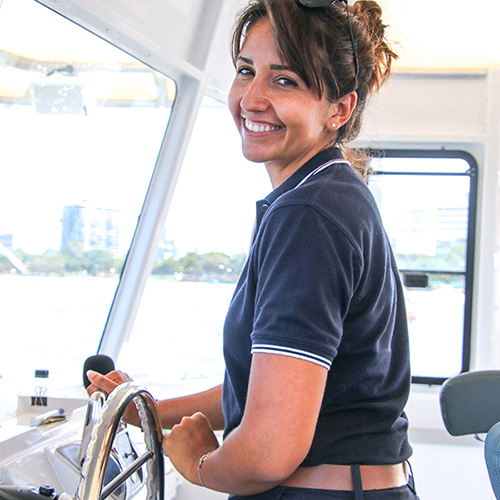
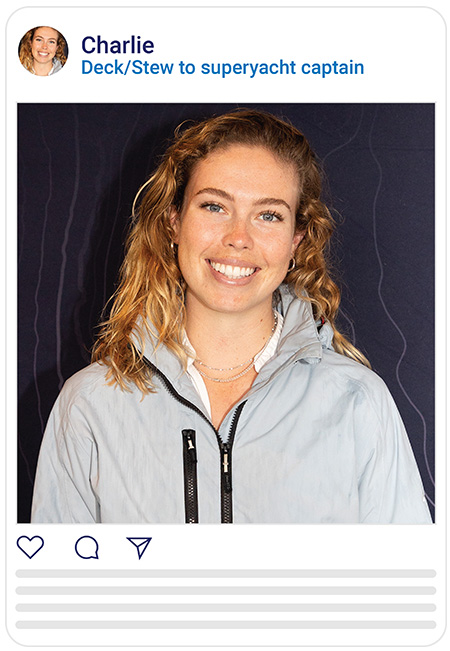
From deck/stew to captain, Charlie now runs MY Lumir, managing crew, operations, and life at sea with precision.
Charlie
Deck/Stew to Superyacht Captain
Charlie grew up around the marine industry, with both parents working in maritime roles and her father serving as a Yachtmaster and TAFE Queensland maritime trainer. After a childhood spent competing in equestrian show jumping, the pandemic brought her home to Australia — and opened the door to a new career on the water. Her first role was as a deck/stew on a 55 metre superyacht in Sydney, where she also began honing her tender driving skills. Soon after, she joined MY Lumir in a deck/stew position, and within a year stepped up to run the vessel when the captain departed. She has now been Master of Lumir for more than two years.
As captain, Charlie manages the vessel much like a floating business — overseeing crew, contractors, maintenance schedules, finances, safety, and the heads of department across Deck, Engineering, and Interior. Her qualifications include STCW95 + 10, Coxswain <15m, Master <24m, and Master <45m, backed by a lifelong sense of responsibility developed through caring for her horses from a young age. She has also invested deeply in her interpersonal skills and resilience, supported by strong mentorship along the way.
For Charlie, the most rewarding part of her career is mastering the balance between crew leadership, operational safety, and meeting owner expectations. She encourages others to ask questions, trust their abilities, and never let anyone tell them they can’t succeed in the industry.
As the number of large vessels visiting Australia grows and local capacity continues to expand, Charlie is excited about the future of the sector. Over the next few years, she looks forward to continuing her professional development and championing the role of women in maritime leadership.
My parents are my inspiration. From the age of 2 years old, I rode jumping horses. I competed extensively until the pandemic, when I had to return to Australia. Both my parents were in the maritime industry. Dad was yacht master and maritime trainer for TAFE QLD. I was lucky enough to study with him.
My first role was on a 55m Superyacht in Sydney, it was a hybrid deck/stew role. I also started tender driving at this time. Shortly after I was offered a deck/stew role on Lumir, which has a 12m chase boat. Less than a year later the captain resigned, I had learnt plenty about the operating systems on board and basically ran the boat as the Master from there on. I’ve been Captain for over 2 years now.
I’m basically the manager of the boat, ensuring that crew, finances, contractors are managed, the boat essentially operates like a business but not a money making one! I ensure that maintenance schedules are developed and adhered to, daily, weekly, monthly essentially like a floating hotel, along with people management of the heads of department for Deck, Engineering and Interior.
I’m now 24 years old, however, I grew up being totally responsible for my horses, so I had to care and be responsible for something other many myself from a very young age.
Qualifications I have include the STW95 + 10, Coxswain <15M, Master 24, and Master 45.
I’ve had to develop my interpersonal skills and build my resilience, you need very thick skin, I was originally a people pleaser, but I’ve had the opportunity to work on myself and I have been lucky enough to have a great mentor and support system.
I’m in a really good place at the moment, learning the fine balance between crew management, safety and owners wishes.
Don’t ever let anyone tell you can’t do it. No question is a silly question, keep asking again and again until you understand.
There are more and more big boats visiting Australia and our capacity to host these vessels is getting better and better.
I have a love of knowledge and learning especially with this role. I’m looking forward to championing the role of females in this industry.
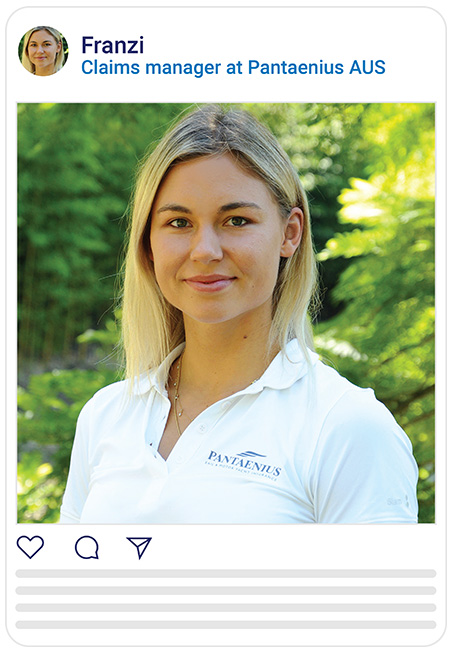
What began as work experience became a career, Franzi now handles complex marine claims at Pantaenius Australia.
Franzi
Claims Manager at Pantaenius Australia
Franzi entered the marine industry almost by accident, seeking work experience while completing a communications degree — but quickly discovered she thrived in the fast paced, problem solving world of marine insurance. Eight years on, she has built a successful career at Pantaenius Australia, where she now manages high value claims and supports the broader team in handling complex loss scenarios. Franzi is known for her investigative mindset, especially when reviewing unusual damage cases or identifying potential fraud, a part of the work she describes as “feeling like a detective.”
Her success has been shaped by strong communication skills, industry mentors, and years spent learning directly from assessors, boat builders, mechanics, and marine experts. She finds the most reward in successful salvage operations — particularly when a customer has lost hope and she helps turn the situation around.
Franzi encourages newcomers to take the leap, ask questions, and embrace being proven wrong as part of learning. With the marine sector continuing to expand, she’s excited about the chance to develop new strategies to better support boat owners. In the coming years, Franzi aims to build on her experience in claims and transition into underwriting and risk management, further deepening her impact on the industry.
To be perfectly honest, I did not actually intend to pursue a career in the marine industry. Initially, I was just looking for some work experience whilst completing my degree but then I found myself thriving within this space, the challenges and opportunities that came with it, and am still here 8 years later with no intention to change direction any time soon.
As the Claims Manager of Pantaenius Australia I assist clients with their high value insurance claims to get them back on the water as soon as possible. I also assist the team in managing their claims, teaching how to better handle loss scenarios, cost management, and reviewing damages in relation to evidence. My favourite part of the role is investigating complex cases where the damages are unusual, or a customer may be submitting a fraudulent claim - it makes me feel like a detective!
My degree is in communications which is quite different to claims handling, though a lot of skills translate to the role. The majority of my skill comes from learning from experts (assessor's, boat builders, mechanics, etc), my own research, my mentors, and from general time and experience.
There is no specific moment but any time we complete a successful salvage operation in open oceans or rural areas, there is a high level of satisfaction. Especially if the customer gave up hope and we manage to turn the tide!
Just take the leap and see how you like it, what’s the worst that could happen? And to have the best success - ask all the questions and do not be afraid of being proven wrong, this is the best way to learn quickly.
The industry will no doubt continue to grow, the trends evidence this. This is exciting as it creates a lot of opportunity for development of new strategies for best assisting boat owners and making a positive difference to the industry overall.
I would like to upskill and move from claims management to underwriting and risk management.
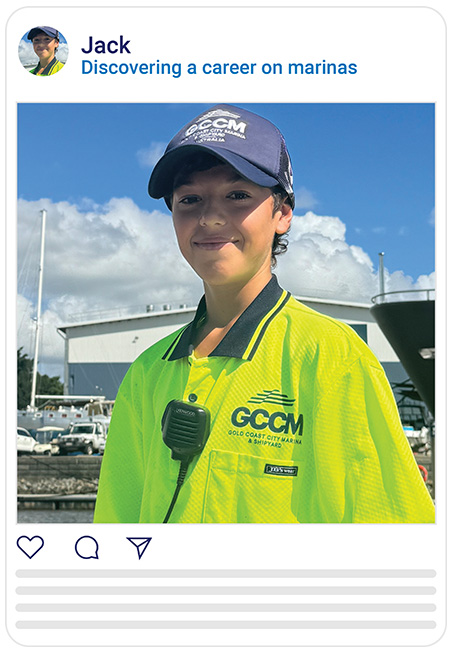
Jack is gaining real-world marina experience at GCCM as he works toward a career on superyachts.
Jack
Discovering a Career on Marinas
Jack discovered the marine industry through school based work experience and quickly realised it offered far more excitement and variety than the career path he originally had in mind. After spending a week at Gold Coast City Marina, where he learned everything from towing boats to splicing lines — and plenty of marina cleaning — Jack knew he had found an industry he genuinely enjoyed. No other work experience matched the energy, skills, and sense of fun he found on the marina.
Jack now works part time at GCCM while completing Year 12 at The Industry School and studying for his Certificate III in Supply Chain Operations. The role gives him hands on experience, exposure to different aspects of marina operations, and the chance to build relationships with boat owners and industry professionals. For Jack, the happiest moments involve being part of the buzz of the marina — seeing people prepare for their adventures and being part of a community that’s always on the move.
He encourages young people to try a range of roles and businesses within the marine industry before choosing a path, as exploring different opportunities is the best way to discover where you thrive. Jack is excited by the rapid evolution of marine technology, from advanced travel lifts to automatic docking systems, and the innovations shaping the future of boating.
Over the next few years, Jack aims to gain his Coxswain’s qualification and eventually work aboard a superyacht, continuing to grow within the close knit and dynamic marine community.
I started through work experience, I originally wanted to be an electrician. I heard about BIA and the marine industry through my school, The Industry School. My very first work experience was with Gold Coast City Marina, where I mainly worked on the dock for the week, I got to experience so many aspects, including towing boats, learning to splice and lots and lots of cleaning!
I did complete other weeks of work experience outside the marine industry, but nothing was as much fun as working on the marina.
I’m working at GCCM on a part time basis, school holidays and weekends. This allows me to continue to study at The Industry School and finish Year 12 whilst I am also completing my Cert. 3 in Supply Chain Operations.
I’ve got to meet some great people and built relationships with many boat owners, it’s such a happy environment, lot’s of smiles when everyone is coming and going from their big adventures on their boats.
Make sure you try multiple roles and businesses before you commit, don’t go with the first one. You might like the first one, but you’ll never know what opportunities will come up, you need to explore the industry.
I am seeing more machinery and technology upgrades, it’s very exciting to see what’s happening, for example with travel lifts, automatic docking of boats, it’s mind blowing what boats are able to do these days.
I want to get my Coxswain’s qualifications and eventually I’d like to work on a superyacht and explore and enjoy the close knit community in the marine industry.
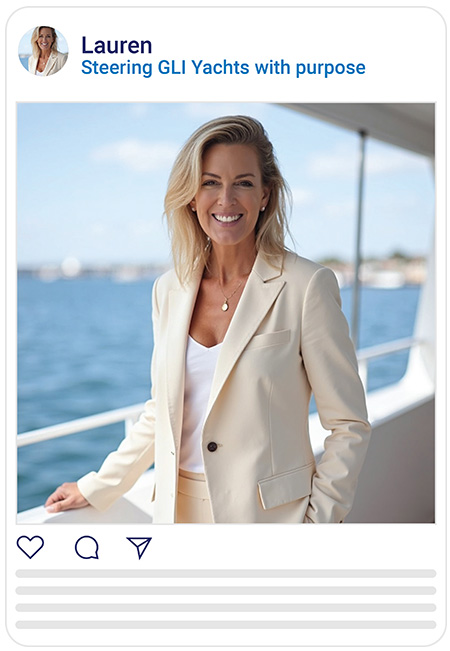
From travel agent to General Manager, Lauren now leads GLI Yachts with over two decades of industry experience.
Lauren
Steering GLI Yachts With Purpose
Lauren’s career in the marine industry evolved naturally rather than by design. After starting out as a travel agent, she moved into a charter management role at Geoff Lovett International at just 25 and quickly discovered the scale, depth, and opportunity within the sector. Over two decades, Lauren has developed a broad skillset across accounts, sales, marketing, operations, and client service, supported by strong mentorship from industry leaders and a workplace culture that encouraged her growth from day one.
Today, Lauren is the General Manager of GLI Yachts, overseeing the full operations of the business — including team leadership, marketing direction, broker support, boat show coordination, and ensuring a consistently high standard of client experience. Known for her organisation, consistency, and commitment to continual improvement, Lauren’s cross department knowledge underpins every aspect of her leadership.
Career highlights include relocating GLI to its new home at The Boat Works and building long standing relationships with clients and colleagues — a testament to her reliability and professionalism. Lauren encourages newcomers to embrace the industry’s diversity, stay adaptable, and commit to learning across multiple areas, as the opportunities are limitless for those willing to put in the effort.
Looking ahead, Lauren is focused on supporting the continued growth of GLI Yachts, strengthening the company’s position in the premium yacht sector, and championing its brands in the Australian market. Her personal goal remains the same as ever: continual refinement, strong team capability, and ensuring the business is set up for long term success.
My career in the marine industry wasn’t something I mapped out from day one. It evolved. I originally worked as a travel agent and realised I was looking for a role that offered greater challenge, growth and long-term opportunity. When I joined Geoff Lovett International at 25 as a charter manager, I quickly recognised the depth and diversity within the marine sector.
Over the past two decades, the industry and particularly my mentors Perry James (GLI Owner and Managing Director) and Industry Icons such as Col McPherson have given me continuous opportunities to learn, take on responsibility and broaden my skillset. GLI having been instrumental in that journey. Perry, Geoff and the team fostered an environment where development was encouraged, not limited. I was exposed to accounts, sales, marketing and operations, and that cross-department experience built a strong foundation that still underpins my role today. What inspired me to stay was the culture: a team that genuinely supports each other and a company that invests in its people.
My first role was as a private yacht charter broker. It was a fast-paced introduction to the industry and required a high level of coordination between vessel owners, captains and clients. Matching client expectations with the right vessels and destinations demanded attention to detail, communication skills and strong organisational ability.
That role gave me a practical understanding of how the industry functions at an operational level and provided a strong grounding in client service, something that has remained central to every position I’ve held since.
As General Manager at GLI Yachts (Geoff Lovett International), my role spans the overall operation of the business. That includes team leadership, office management, marketing direction, boat show coordination, broker support and ensuring a consistent client experience across all touchpoints.
It’s a role that has developed progressively over 20 years rather than appearing overnight. Each stage of my career at GLI added another layer of responsibility, and the trust placed in me by Geoff and then by Perry when he bought the business from Geoff in 2015 allowed the position to evolve alongside the company’s growth. My focus is on maintaining standards, supporting our team and ensuring the business continues to operate efficiently and professionally.
Consistency, organisation and a commitment to continual improvement have been key. The marine industry is relationship-driven and detail-oriented, so the ability to manage moving parts while maintaining strong communication is essential.
I’ve also benefited from working in multiple areas of the business over the years, which has provided practical knowledge rather than just theoretical understanding. Above all, I take pride in maintaining high standards and being open to learning, even after two decades, there is always something new to understand or refine.
Relocating the GLI office to The Boat Works stands out as a particularly rewarding milestone. It was an opportunity to help shape not only the physical space but also the client experience and team environment. Seeing that transition come together successfully was very satisfying.
Equally rewarding has been the longevity of relationships: both with clients and colleagues. Being trusted by long-term clients and acknowledged for consistency and reliability within the industry is something I value highly.
Be prepared to learn broadly and stay adaptable. The marine industry is diverse, it combines technical knowledge, client service, logistics, finance and marketing. If you are willing to develop across multiple areas and commit to doing things properly, it can be an incredibly rewarding sector.
The opportunities are there for those who are prepared to put in the effort.
The marine sector continues to grow, particularly on the Gold Coast where ongoing development and infrastructure investment are strengthening the ecosystem for businesses and clients alike.
What excites me most is the increasing level of professionalism and innovation within the industry. As facilities like our amazing Boat Works home, the technology available and client expectations evolve, so do the opportunities for businesses that are prepared to adapt and maintain strong standards.
My primary goal is to see GLI continue to build on its reputation for professionalism and integrity while expanding opportunities within the premium yacht sector.
Supporting our incredible brands, Baglietto Yachts, Selene Yachts, Castoldi Tenders, Fairway Yachts and Deep V to continue their development in the Australian market is an exciting prospect.
On a personal level, my focus remains on continual improvement. Refining processes, strengthening our team capability and ensuring that GLI Yachts remains well-positioned for long-term success.
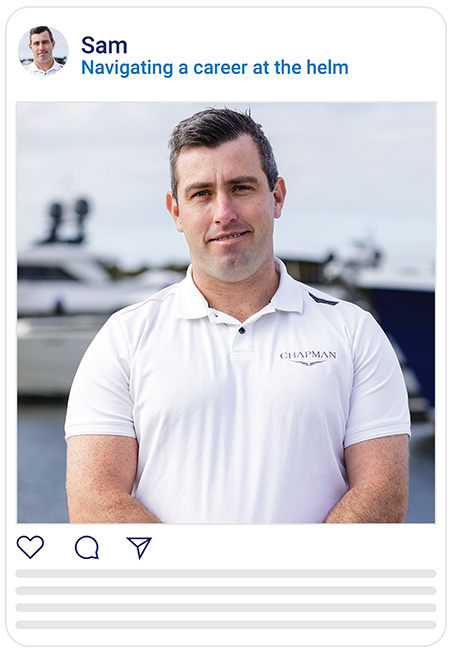
Sam leads Chapman Gold Coast, bringing real-world maritime experience into yacht refit operations.
Sam
Navigating a Career at the Helm
Sam’s marine career began unexpectedly. While studying for his pilot’s licence, he joined friends fishing in the Gulf of Carpentaria to fund his training — an experience that ultimately steered him toward life on the water. At 19 he completed his STCW95 and secured a junior deckhand role on a 50 metre world cruising superyacht. Guided by a supportive captain, Sam earned his Master of Yachts 200GT certification within two years, opening the door to further study at the Australian Maritime College and commercial roles across the Northern Territory and Gulf of Carpentaria, eventually serving as Chief Officer on an 80 metre landing barge.
Today, Sam is Managing Director of Chapman Gold Coast, overseeing the refit and yachting services division. His role spans business operations, project management, client relationships, and the delivery of high quality yacht refits. Built on strong maritime qualifications and leadership experience gained managing multiple departments on board superyacht Oneworld, Sam brings both technical and managerial strength to his work.
For Sam, the most rewarding moments have been spent on world cruising superyachts, exploring remote regions few people ever see. He encourages newcomers to embrace the challenge, the variety, and the opportunities the industry offers — no two days, boats, or clients are ever the same.
Looking ahead, Sam is excited by advancements in hybrid and electric technologies and the evolution of yacht design. His goal over the next few years is to drive the growth of Chapman’s Queensland division and help establish its reputation for excellence in yacht refit and services.
I never planned to, I was studying for my pilot’s licence, at that time my mates were fishing in the Gulf of Carpentaria, and I needed money for my studies, so I joined them for a 3-month season. After my second season, I realised that fishing wasn’t the most viable option.
At 19 I completed my STCW95 and applied for a junior deckhand job on a 50m world cruising yacht, as one of 12 crew. I was lucky as the captain became a mentor to me and encouraged me to get my tickets and after two years, I had obtained my Master of Yachts 200GT certification.
This role led me to the Australian Maritime College (AMC) in Launceston to study for my Master 45, which led to work opportunities in commercial shipping in The Northern Territory and Gulf of Carpentaria, taking on a role as Chief Officer on an 80m landing barge.
During my time at AMC in Launceston, I met Cooper Chapman of Champaman Marine and on my return to Sydney, I worked as a relief skipper and Captain.
I’m Managing Director at Chapman Gold Coast, where I manage the Refit and Yachting services here in QLD. This involves day to day business operations, project management for yacht refits. Together with business development and client relationships.
As well as my maritime qualifications, I was able to develop my management skills working on the superyacht "Oneworld" managing all the departments and aspects of the vessel as business centres.
A.) Working on board a world cruising superyacht and have the opportunity to explore some of the most remote places on earth.
Do it! It’s very rewarding, there are so many different career paths, no day is the same, no boats are the same and no clients are the same. You will get to meet some great people. Enjoy the challenge that every day brings. Be prepared to stick with it, it’s hard work, but the rewards are outstanding.
The introduction of new technologies hybrid, electric into yacht design concepts the incorporation of new materials in the build of yachts.
The Queensland business is a new division for Chapman and I want to be a big part of that growth by achieving a reputation for excellence in yacht refit and services.
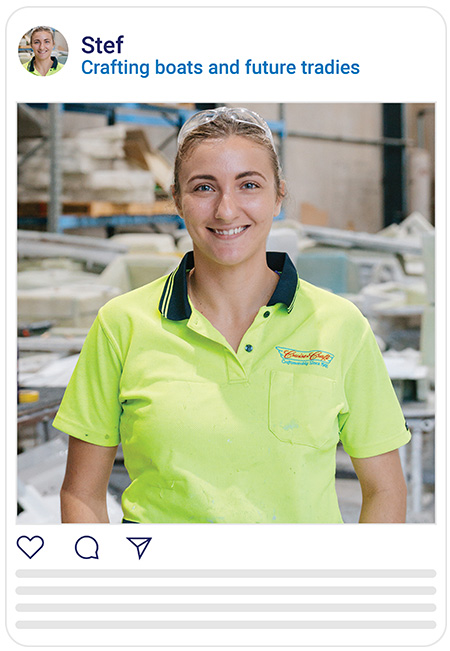
As an Award-winning boatbuilder, Stef now guides apprentices while crafting vessels from the ground up.
Stef
Crafting Boats and Future Tradies
Stef entered the marine industry with no prior experience, stepping into a labouring role at Cruise Craft after applying for hundreds of carpentry apprenticeships. Cruise Craft recognised her potential, and Stef threw herself into the work, completing her Certificate III in Marine Craft Construction and going on to win both the Queensland and National BIA Apprentice of the Year awards in 2022.
Today, Stef is a Fibreglass Boat Assembler and Small Parts Team Leader, managing a component department and guiding two apprentices through their own training journeys. She thrives on teaching, teamwork, and the satisfaction of crafting boats from the ground up. Known for her adaptability, multi skilling and strong technical capability, she continues to build her influence by supporting others in the industry through practical advice and mentorship.
Stef’s story shows that with determination, the right attitude, and a willingness to learn, it’s possible to build a rewarding and meaningful career in marine manufacturing — even without a boating background. She is driven by continuous improvement and hopes to one day pass on her knowledge as a TAFE trainer, inspiring the next generation of boat builders.
It all started when I was a 22 with no industry experience, I never even gave the industry a thought. I applied for 300 carpentry apprenticeships with no luck, until I saw a job advertised at Cruise Craft, just a labouring role. Cruise Craft believed in me. I stuck to it and put in 110% effort, finishing my four year apprenticeship and winning both QLD and National BIA Apprentice of the Year in 2022.
I didn’t even think I would get started, let alone win an award. I didn’t grow up on the water, it was something I picked up as an adult. I was a recreational fisherman, and before I knew it, I was an apprentice. I had to learn about being around boats. I only knew what a hull was, and port and starboard, that was it!
I manage a small component department, I have two apprentices working with me, and I get to be involved in their training. I can share my enthusiasm and inspire them to work together as a team. It’s really cool to be able to teach people stuff. I’ve been in the industry for six years now and get to share my experience with the younger generation.
Definitely completing my Apprenticeship in Marine Craft Construction (Cert III in Marine Craft Construction) plus my win as the BIA Apprentice of the Year in 2022. My soft skills include adaptability, multi-skilling, and transferable skills which can be applied to working with different materials and across other sectors of the industry.
Being given my first apprentice to manage, who now builds boats himself. I was able to give him that skill set, and he continues to work at Cruise Craft. I never realised how much impact I had on him.
I stay active on socials to help other people within the marine industry, from resume writing, tips and tricks and the right tools to use. I’m happy to help anyone with the right attitude.
Give it a red-hot go. There are so many avenues, not just boat building. You can be a surveyor, a trainer, a marine mechanic. You can make something from scratch. We get to craft something we can use. I love working, making, creating, and shaping. Every part has been made by me. Stick at it.
Continuous change. Products are always improving and innovating, and there are opportunities to be better all the time. New models, new details which lead to new skills. It's constantly evolving.
Moving closer to work. Becoming a TAFE teacher. I was taught by one of the best boat builders in Australia, and the knowledge and skills he imparted, I want to teach kids how to do things the right way, the old-school way.
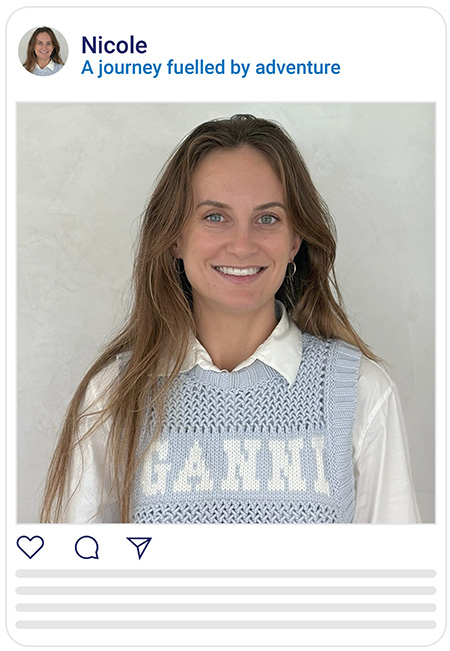
Nicole oversees marketing and development at Chapman, blending yachting experience with business strategy.
Nicole
A Journey Fuelled by Adventure
Nicole’s pathway into the marine industry began with a leap of courage and curiosity. Inspired by a friend working on superyachts and craving a break from traditional study, she and her partner sold everything they owned and booked a one way ticket to Florida — determined to explore the world and see where yachting could take them. That decision led her into a career filled with global travel, life shaping experiences, and opportunities far beyond what she imagined after leaving high school.
Today, Nicole is the Head of Marketing and Development at CHAPMAN, a role that has grown with her over the past year. She oversees front facing branding, social media strategy, business development, and marketing campaigns, while also co leading major industry events alongside the company’s founder. Her background in yachting instilled the professionalism, resilience, and problem solving skills that now underpin her success in the corporate side of the industry, complemented by her Business degree from the University of Queensland.
Some of Nicole’s most memorable moments come from the extraordinary experiences she gained at sea — from swimming with hammerheads in the Galapagos to climbing active volcanoes in Indonesia. She encourages anyone considering the industry to embrace it wholeheartedly but be prepared to work hard, uphold strong standards, and stay consistently professional.
Looking ahead, Nicole is excited by a more progressive, diverse, and environmentally conscious future for the marine sector, and by the rising interest in expedition yachting and new global cruising grounds. With more superyachts exploring the South Pacific and Australia, she sees enormous opportunity for growth and evolution within the industry.
I was inspired by a friend who had entered the superyachting industry and was suddenly jet skiing in the Bahamas, travelling the world, and experiencing an entirely different way of life. At the time, I was feeling burnt out from studying straight after high school, and it made me realise there was a bigger world to explore. My boyfriend and I made the decision to put everything on hold, sold what we owned, and bought a one-way ticket to Florida... knowing we could always return to our studies if we chose to.
I am the Head of Marketing and Development at Chapman, a role that has naturally evolved over the past year. I oversee all front-facing branding and marketing initiatives, from social media strategy through to broader business development and campaign execution. I also co-lead the delivery of large-scale industry events alongside the founder, which has become a particularly rewarding extension of the role.
Yachting instilled in me a strong sense of professionalism, punctuality, resilience, and a solution-focused mindset under pressure. These skills, combined with a strategic way of thinking, have been invaluable in business. I later returned to complete my Business degree at the University of Queensland, which has provided a solid academic foundation to support my industry experience.
Some of the most rewarding moments have been the rare, pinch-me experiences that only a small number of people will ever encounter. From swimming with hammerheads in the Galapagos to climbing active volcanoes in Indonesia, these opportunities have been unforgettable. Yachting has allowed me to experience parts of the world in a truly extraordinary way.
My advice is simple: do it!!! But be prepared to work incredibly hard. The effort you put in will come back to you in opportunities and growth you can't imagine.
Pro tip: Remember that five minutes early is on time, and on time is late. that mindset will set you apart and will never go unnoticed.
I see the industry becoming more progressive, diverse, and environmentally conscious, with greater inclusivity and fewer outdated expectations. There is also growing interest in explorer yachts and destinations beyond the traditional Mediterranean and Caribbean circuits. With more superyachts heading toward the South Pacific and Australia, it is an incredibly exciting time to be involved.
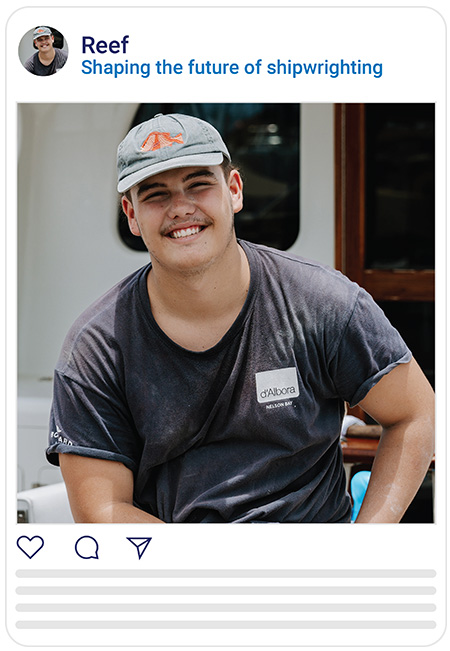
Reef is part of the next generation of marine talent, developing skills as an apprentice shipwright at GCCM.
Reef
Shaping the Future of Shipwrighting
Growing up around boats and charter fishing, Reef James was always destined for life on the water. With family deeply embedded in the marine industry, Reef started young—spending weeks at sea on fishing and black marlin charters before turning that passion into a career.
Now an apprentice shipwright with Lighthouse Shipwrights at Gold Coast City Marina, Reef’s days are hands‑on and fast‑paced, tackling everything from antifouling and fibreglass to timber and gelcoat work. He’s already achieved his Master <24m and is completing a Certificate III in Marine Craft Construction, with plans to gain his MED2 next.
For Reef, the marine industry offers endless opportunity, real job security, and a future he’s excited to build—on and off the water.
My family. Everyone in my family is part of the industry, in some way, shape, or form.
From a very young age, I accompanied my dad as Skipper on fishing charters. My family has always had boats. I've visited the Great Barrier Reef multiple times with him, staying out for 7 days and up to a month at a time, operating fishing and black marlin charters.
Last year, I completed my Master V with Paradigm Training Group on the Gold Coast.
I'm currently working as an apprentice with Lighthouse Shipwrights at Gold Coast City Marina (GCCM). I'm in my first year and will soon be completing blocks training at TAFE QLD Coomera Marine campus to study a Certificate III in Marine Craft Construction.
My days are flat out, doing everything and anything—lots of antifouling, gel coat, fiberglass, timber work, there are endless tasks right across the board.
My Master V certification with Paradigm, which allows me to master a vessel up to 24m commercially I undertook this as a school-based training, and became qualified in September 24. I also have a High School Diploma of Business from Southport State High (Years 10, 11, and 12), a Cert 2 in Marine Craft Construction (school-based at TAFE) Once I finish my apprenticeship I will work towards my MED2 Marine Engine Driver certification.
To be honest, getting my ticket for Master V has been one of the most rewarding moments.
It's a no-brainer. There are endless opportunities to get boats always need to be fixed—it's very cool. Marine qualifications can be harder to achieve is but there's the opportunity to switch in and out of the industry because of the skill set. Being on the Gold Coast is amazing, with the biggest marine precinct in the region. The marine precinct is it's growing each year, bringing along with the opportunities to grow as well.
At Lighthouse, we cover all bases of shipwright work. TAFE only had 3 students registered when I attended; we need to get the message out there with younger people about the opportunities the industry hold for them.
I want to become a qualified shipwright, obtain my MED2, and buy a house soon.
MARINE JOBS BRINGING BUSINESS
AND EMPLOYEE TALENT TOGETHER.
For help and support you can contact us via email.
Marine Jobs and Boating Industry Association Ltd. acknowledges the Traditional Owners of the land in which our organisation stands, and extends this respect to all First Nations people, including past, present and emerging.